EAS 2026 · European Astronomical Society Annual Meeting · Lausanne, Switzerland eas.unige.ch/EAS2026 ↗
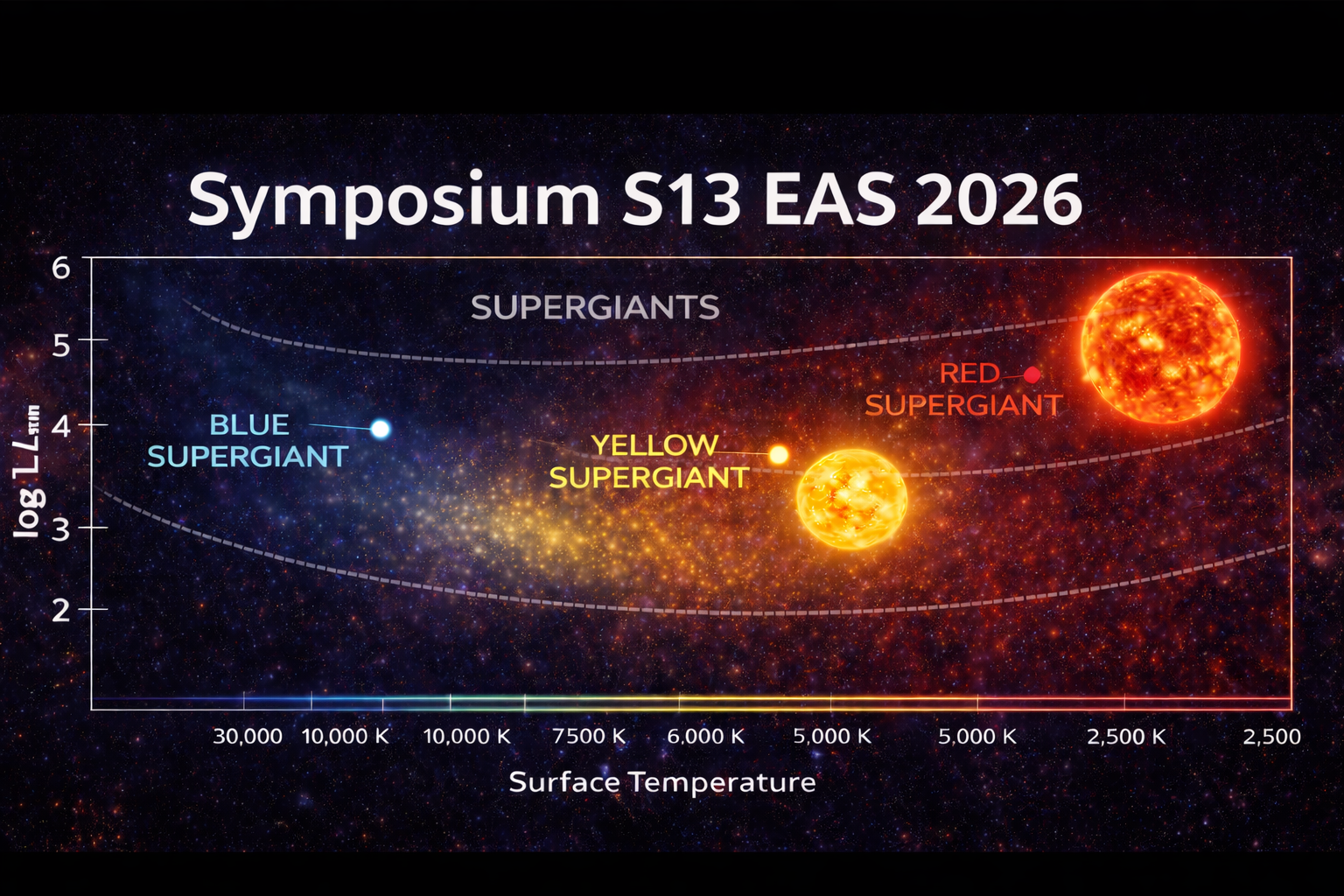
Hertzsprung-Russell diagram showing blue, yellow and red supergiants — Symposium S13 EAS 2026

EAS 2026 · Symposium S13 · Stellar Astrophysics

Massive Supergiants in Focus: Single, Binary and Stellar Merger Pathways across the Hertzsprung–Russell Diagram

Wednesday 1 July & Friday 3 July 2026
Rooms 1BC (1 Jul) · Room 3A (3 Jul) · SwissTech Convention Centre, Lausanne
6 sessions · 38 talks + discussion
Chairs: Athira Menon & Lee Patrick
SOC: Alceste Bonanos, Alex de Koter, Norbert Langer, René Oudmaijer

About This Symposium

In the era of large-scale surveys, the myriad evolutionary paths that massive stars take as members of binary systems, products of stellar mergers or as single stars toward their demise as supernovae and their resultant remnants, require systematic investigation. Central to this are the massive supergiants, which are the brightest stars in stellar populations that can be observed at large distances, but whose origin, evolutionary status and eventual fates are uncertain.

In this meeting, we will unite theorists and observers to develop a holistic framework linking post main-sequence massive stars to their transient endpoints and cumulatively assess:

  • Assess the evolutionary connections between different populations of evolved massive stars (e.g. BSGs, YSGs, RSGs, LBVs, B[e]SGs, hypergiants) using their stellar and binary properties (e.g. mass-loss, multiplicity, rotation rates, mergers, runaways, etc.)
  • Assess the missing physics in rapid simulations and detailed modelling that could bias current predictions
  • Connect the observed diversity of supernovae to supergiant progenitors
  • Explore explodability and compact object formation predictions from supergiant models
  • Exploit minority binary channels, including semi-detached binaries, Be stars and high-mass X-ray binaries, as laboratories to study mass transfer and constrain binary evolution

Programme

Wednesday 1 July 2026

S13a 09:00–10:30 · Room 1BC
Session chair: Lee Patrick
09:00–09:05
Opening
Welcome and Introduction
Athira Menon · Columbia University
09:05–09:30
Invited Talk
The varied lives of massive supergiants
Ignacio Negueruela · Universidad de Alicante
09:30–09:45
Contributed Talk
The molecular fingerprint of early-type supergiants
Cristobal Bordiu · Instituto Astrofísico de Andalucía / INAF
09:45–10:00
Contributed Talk
Chasing the Runners: The First Systematic Search for Runaway Red Supergiants in the Large Magellanic Cloud
Alejandra Fernández Rio · Centro de Astrobiología (CAB) CSIC/INTA
10:00–10:15
Contributed Talk
Stellar neighbourhoods of yellow supergiants and hypergiants in the Milky Way
Anni Kasikov · University of Tartu
10:15–10:30
Contributed Talk
Dusty Red Supergiants and Their Circumstellar Matter
Arkaprabha Sarangi · Indian Institute of Astrophysics
S13b 15:00–16:30 · Room 1BC
Session chair: Athira Menon
15:00–15:25
Invited Talk
Pre-supernova evolution of red, yellow, and blue supergiants
Jorick Vink · Armagh Observatory and Planetarium
15:25–15:40
Contributed Talk
Merger-Born Blue Supergiants: A Unified Origin Across Metallicity
Xinuo Wang · Cornell University
15:40–15:55
Contributed Talk
The Role of Eruptions and Accretion in Shaping Massive Star Evolution
Bhawna Mukhija · Ariel University
15:55–16:10
Contributed Talk
TIME to Study Mass Transfer: the New 3D Horizon for Binary Evolution
Davey Dickson · KU Leuven
16:10–16:25
Contributed Talk
Local MHD Simulations of Common-Envelope Evolution
Damien Gagnier · Heidelberg University & HITS
S13c 17:00–18:30 · Room 1BC
Session chair: Athira Menon
17:00–17:25
Invited Talk
Observing evolved massive stars with current and upcoming observing facilities
Lee Patrick · Centro de Astrobiología (CAB) CSIC/INTA
17:25–17:40
Contributed Talk
Spatial and spectral constraints on resolved mass-loss of the massive Post-RSG star IRAS 17163–3907 and its Fried Egg Nebula
René Oudmaijer · Royal Observatory of Belgium
17:40–17:55
Contributed Talk
Unveiling companions and binary interaction of red supergiants with VLTI-GRAVITY
Daniel Jadlovský · European Southern Observatory & Masaryk University
17:55–18:10
Contributed Talk
Betelgeuse B and the red supergiant multiplicity
Miguel Montargès · LIRA - Observatoire de Paris
18:10–18:25
Contributed Talk
MeerKAT New Insights into Evolved Massive Stars and Puzzling Rings
Filomena Bufano · INAF-OACT

Friday 3 July 2026

S13d 09:00–10:30 · Room 3A
Session chair: Lee Patrick
09:00–09:25
Invited Talk
Supergiants as Supernova Progenitors: From Direct Detections to Diverse Endpoints
Justyn Maund · Royal Holloway, University of London
09:25–09:40
Contributed Talk
The pre-merger evolution of binary stars: insights from Luminous Red Novae
Nadejda Blagorodnova · Universitat de Barcelona
09:40–09:55
Contributed Talk
Probing common-envelope evolution in massive binaries using observations of stellar merger transients
Viraj Karambelkar · Columbia University
09:55–10:10
Contributed Talk
The Last Breath of Massive Stars: a Panchromatic Census of Galactic Red Supergiants on the Brink of Core-Collapse
Mario Lauriano · INAF-Osservatorio Astronomico di Palermo & Università di Padova
10:10–10:25
Contributed Talk
The changing nature of WOH G64: spectral evolution and implications for pre-supernova evolution
Wasif Shaqil · Astrophysics Research Institute (LJMU)
S13e 15:00–16:30 · Room 3A
Session chair: Athira Menon
15:00–15:25
Invited Talk
Binary evolution and the diversity of core-collapse supernovae
Andrea Ercolino · Argelander Institut für Astronomie, Universität Bonn
15:25–15:40
Contributed Talk
The binary origin of the red supergiant progenitor of the Type II SN 2018gj
Manos Zapartas · University of Athens / FORTH
15:40–15:55
Contributed Talk
Blue supergiants as a progenitor of intermediate-luminosity red transients
Takashi Moriya · National Astronomical Observatory of Japan
15:55–16:10
Contributed Talk
The least massive black holes from failed explosions of massive supergiant supernova progenitors
Kiril Maltsev · Max-Planck-Institute for Astronomy
16:10–16:25
Contributed Talk
Assembly of circumbinary disks during runaway mass transfer and the implications for Luminous Red Novae
Ondrej Pejcha · Charles University
S13f — ePoster Session and Discussion Session 17:00–18:30 · Room 3A
Session chair: Lee Patrick Discussion chair: Athira Menon
17:00–17:02
ePoster
Binary interaction or single evolution? Probing the nature of extreme luminous BSGs in Cygnus OB2
Sara R. Berlanas · ULL and IAC
17:02–17:04
ePoster
The most luminous star in the low metallicity cluster NGC 346 as a merger product
Armin Mang Roman · University of Potsdam
17:06–17:08
ePoster
The search for interacting binary systems in the Milky Way
Gerard Garcia Moreno · Universitat de Barcelona
17:08–17:10
ePoster
How common are binaries among Blue Supergiants? Binary statistics from the BLOeM survey in the SMC
Zehava Katabi · Tel Aviv University
17:12–17:14
ePoster
A new PARSEC v2.0 grid of evolutionary tracks: from 2 to 2000 solar masses across all metallicities
Guglielmo Costa · University of Padova
17:16–17:18
ePoster
Understanding convection in massive supergiants with 3D stellar simulations
Federico Rizzuti · HITS Heidelberg
17:18–17:20
ePoster
Comparative Study of Two Luminous Red Novae: Progenitor Modeling and Dust Formation
Maxime Wavasseur · University of Barcelona
17:20–17:22
ePoster
A Future Luminous Red Nova from Betelgeuse: Predicting a Stellar Merger
Naunet Leonhardes-Barboza · UC Santa Cruz
17:22–18:25
Discussion
Open questions in Evolved Massive Star evolution
Chair: Athira Menon · Panel: Invited Speakers
18:25–18:30
Closing
Closing address
Athira Menon & Lee Patrick

Scientific Organisers

Chair
Athira Menon
Columbia University
Chair
Lee Patrick
Centro de Astrobiología (CAB) CSIC/INTA
SOC Member
Alceste Bonanos
IAASARS, National Observatory of Athens
SOC Member
Alex de Koter
University of Amsterdam
SOC Member
Norbert Langer
Argelander-Institut, Universität Bonn
SOC Member
René Oudmaijer
Royal Observatory of Belgium